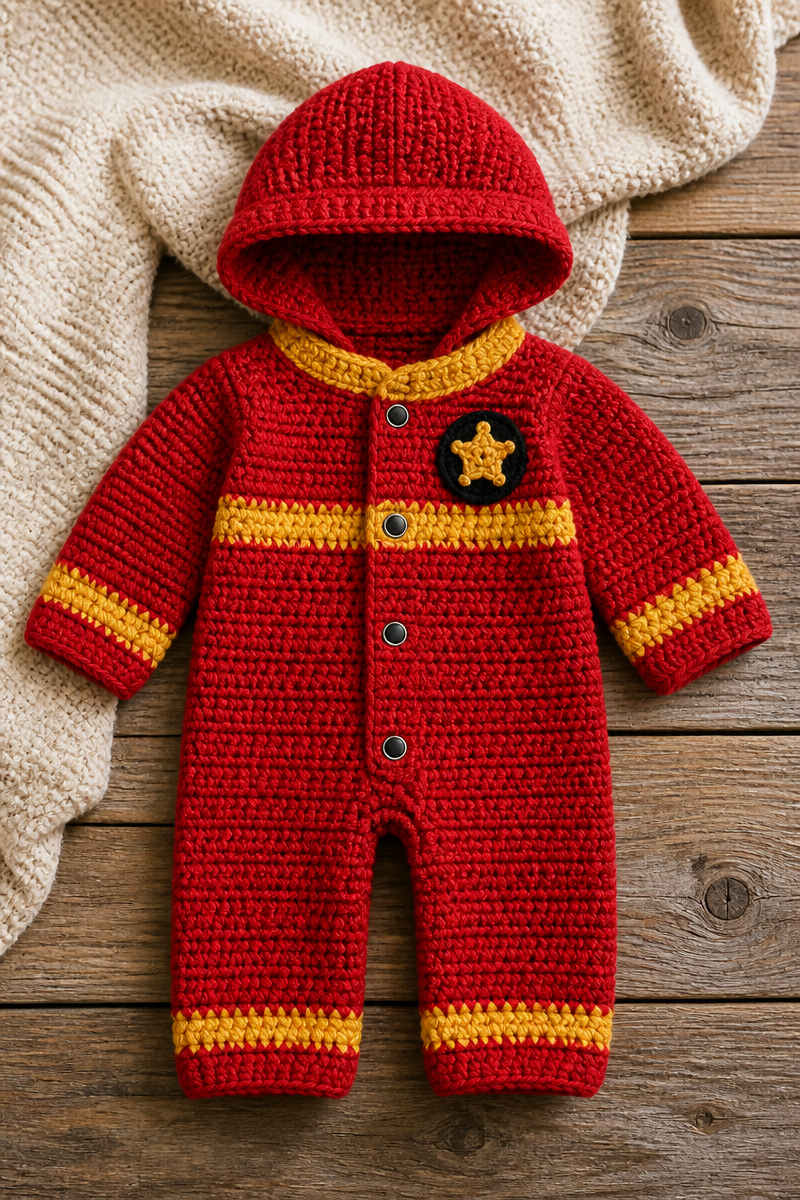
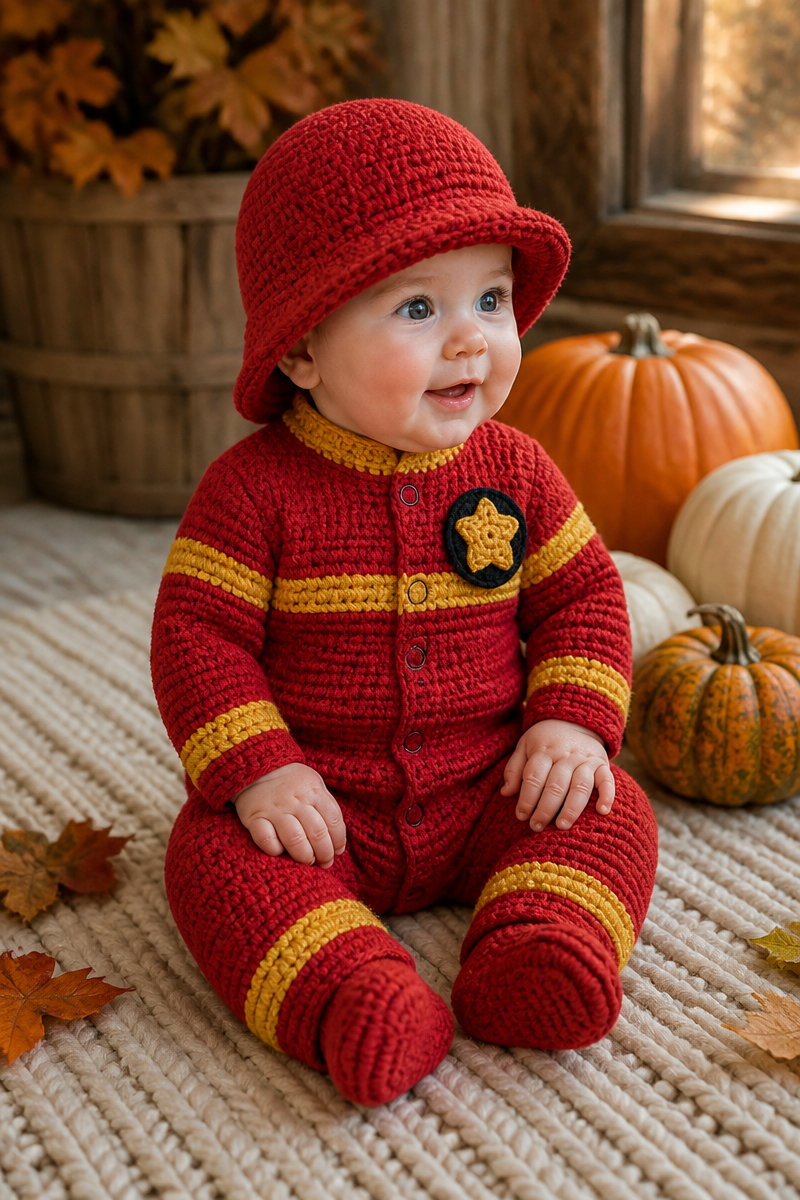
This baby firefighter costume set combines practical garment design with simple crochet construction methods to create a comfortable, functional outfit. The jumpsuit is worked in the round from a magic ring, increasing to a set stitch count before splitting for separate leg shaping and snap closures along the front for easy dressing. The hood mimics a firefighter’s helmet with shaping through rounds and a styled visor formed by front-only double crochets. Reflective-style yellow stripes enhance authenticity and safety visuals, applied around cuffs, collar, and across the chest. A felt-and-crochet badge completes the look.
The worsted weight acrylic blend yarn strikes a balance between durability, ease of care, and softness suitable for infant wear. While cotton alternatives provide breathability, acrylic stands up better to multiple washings without losing shape or vibrancy in red tones. The 5.0mm hook ensures a sturdy fabric with defined stitches but retains some stretch, vital for baby garments.
Designed to fit infants 6 to 12 months, this costume set is straightforward to construct yet detailed enough to capture a mini firefighter’s spirit. The modular components—the jumpsuit body, trim stripes, and helmet hood—allow clear assembly and finishing steps, ensuring a neat, polished result. Three snap fasteners secure front closure comfortably without bulky buttons or ties.
Why You’ll Love This Set
The jumpsuit’s tubular construction transitions smoothly from body to legs, providing shaping for leg openings and an explicit front opening with snap fasteners for easy on and off. The helmet hood is cleverly shaped by consistent rounds with an added front brim created by selective double crochets, bridging form and function. The yarn’s washable acrylic blend delivers a structured but soft hand suitable for active babies, while the contrasting yellow stripes are quick accents applied with simple rounds of single crochet to mimic reflective gear. This set requires only standard stitches and basic assembly steps, making it accessible yet distinctive.
Materials
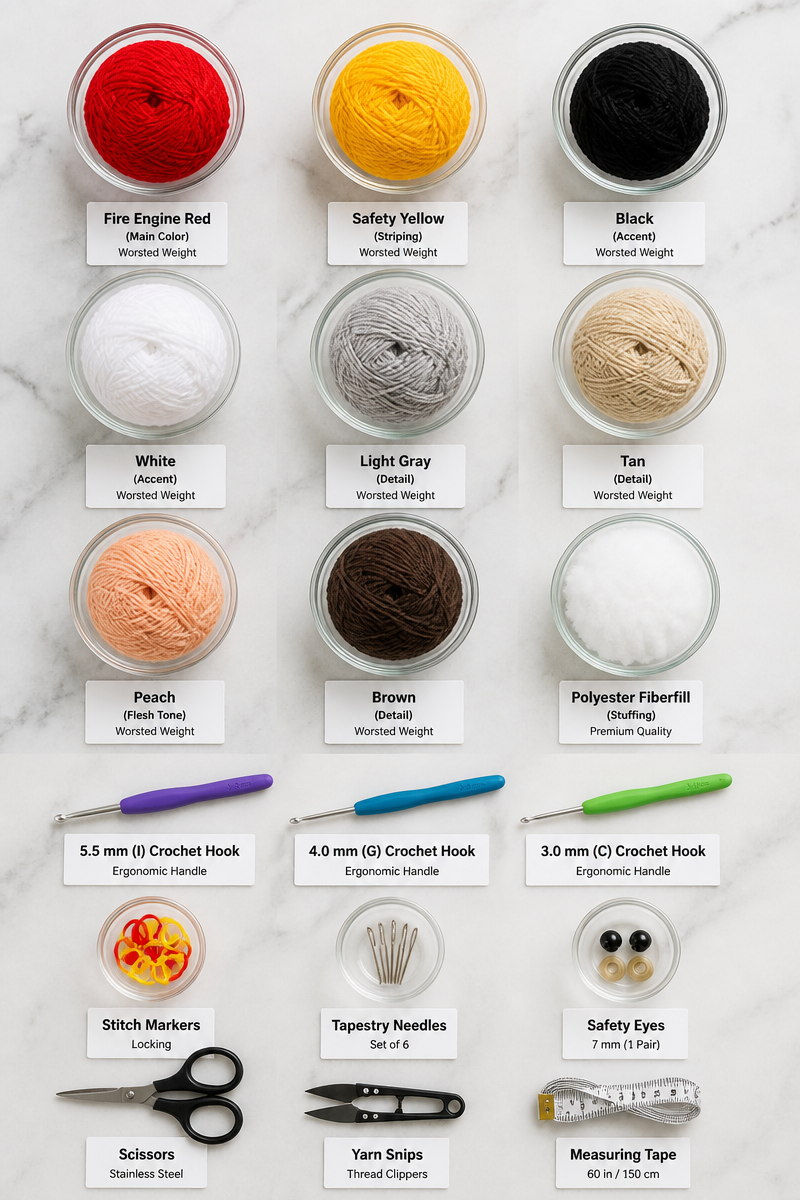
- Hook: US H/8 (5.0mm) crochet hook
- Yarn: Worsted weight #4 acrylic blend
- Main color: fire engine red, approx 150g / 320 yards
- Accent color: golden yellow, approx 20g / 45 yards
- Notions: yarn needle, 1 stitch marker, black felt for badge center and boot details, fabric glue, 3 snap fasteners for front closure
Gauge
12 single crochets x 14 rows = 4 inches (10 cm) in single crochet stitch pattern
Finished Size
Fits baby 6–12 months
- Jumpsuit circumference: 24 stitches per round (~8 inches, or 20 cm width around torso)
- Leg circumference: 12 stitches per leg (~4 inches, or 10 cm circumference)
- Helmet hood circumference at base: 24 stitches (~8 inches or 20 cm) matching jumpsuit neckline
Special Stitches and Techniques
No special stitches beyond standard single crochet (sc), double crochet (dc), increases (inc = 2 sc in the same stitch), and slip stitch (sl st). The helmet visor is created by working double crochet stitches only into the front loops of the designated stitches for shaping a small brim.
Abbreviations
- ch = chain
- sc = single crochet
- dc = double crochet
- sl st = slip stitch
- st(s) = stitch(es)
- rnd = round
- row = row
- inc = increase (2 sc in same st)
Acrylic Blend Yarn Tips
This worsted acrylic blend holds stitch definition well, making the increases and the visor shaping clearly visible. The yarn is smooth but has enough bulk to produce warm fabric without excess stiffness. Maintaining consistent tension is crucial to avoid overly tight stitches, especially in small rounds at the top of the helmet dome. Acrylic yarns dry quickly and resist pilling but can melt or deform under high heat; wash and block gently at low temperatures. The yarn’s resilient nature is ideal for baby wear that will face frequent washing and active use.
Options for Substitutions
- Cotton worsted yarn: softer and more breathable but less elasticity; may affect fit and stretch slightly. Use same hook for gauge.
- Superwash wool blend worsted weight: warmer and natural fiber; careful with washing instructions to avoid felting.
- Bulky (#5) yarn with 6.0mm hook: faster to work, more textured, adjust stitch count upward to maintain size.
- Different colorways: substitute main red and yellow with any high-contrast colors to mimic other emergency services or personalized looks.
- Smaller hook (4.0mm) with same yarn: creates denser fabric and smaller size; adjust stitch counts accordingly.
- Use Velcro closure instead of snap fasteners for easier stress-free dressing and removal; add extra rows if needed to accommodate closure thickness.
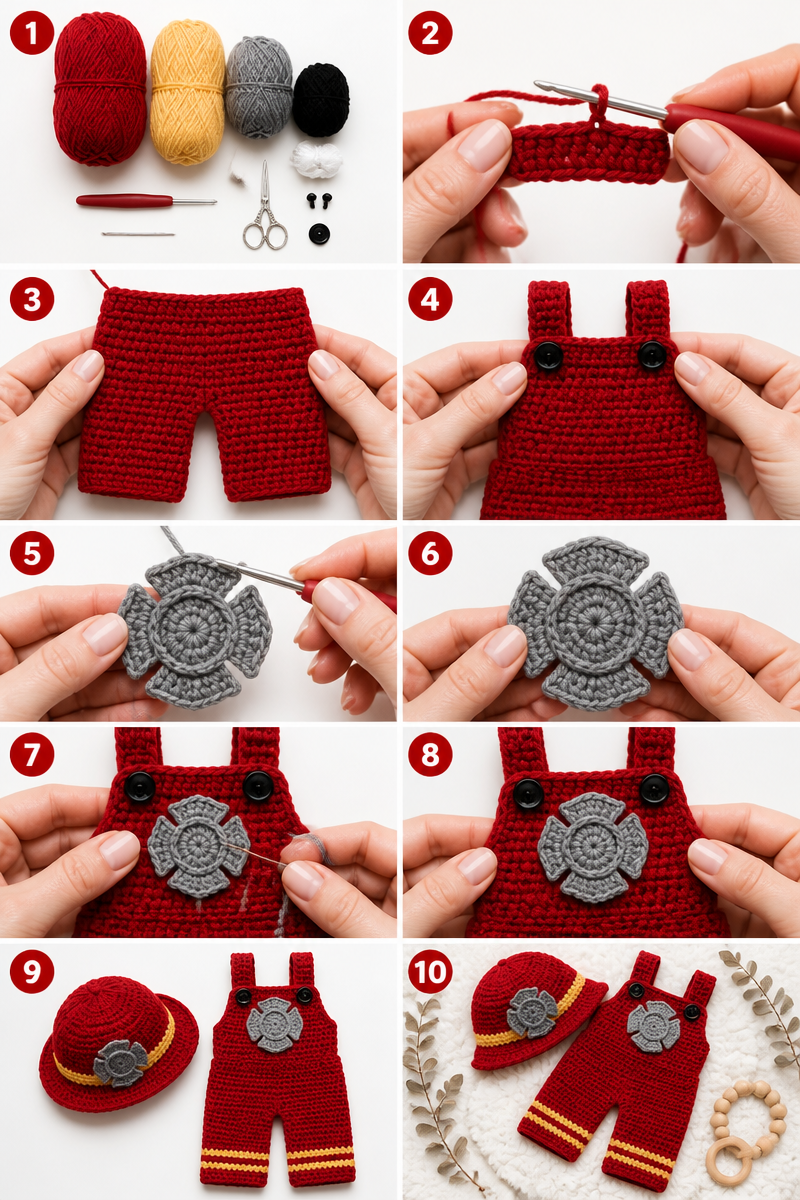
Pattern
Jumpsuit Body (make 1)
With red yarn:
Rnd 1: Ch 2, 6 sc in 2nd ch from hook (6 sts).
Rnd 2: Inc in each st around (12 sts).
Rnd 3: Sc 1, inc repeat 6 times (18 sts).
Check arithmetic: starts with 6 sts; pattern consumes (1+1)=2 sts per repeat, 6 repeats = 12 consumed; produces 18 sts, correct.
Rnd 4: Sc 2, inc repeat 6 times (24 sts).
Repeat unit consumes 3 sts, produces 4 sts per repeat. 24 sts at end matches formula.
Rnds 5–10: Sc in each st around (24 sts each rnd).
Rnd 11: Split into legs: do not join rounds, separate into 2 legs with 12 sts each.
Leg shaping (each leg separately):
Rnds 12–14: Sc in each st (12 sts). Fasten off each leg.
Create front opening by leaving first 3 stitches of each leg’s front side free (i.e., do not join rounds at those sts) and attach 3 evenly spaced snap fasteners along it.
Stripe Trim
With golden yellow yarn, work 1 rnd of sc around each leg cuff (12 sts), the collar (24 sts at neckline), and horizontally across the jumpsuit chest.
Chest stripe: Fold front panels flat to create a horizontal line, sc evenly across matching 6 sts on each front panel (12 sts total) through both thicknesses, simulating reflective safety stripe.
Helmet Hood (make 1)
With red yarn:
Rnd 1: Ch 2, 6 sc in 2nd ch from hook (6 sts).
Rnd 2: Inc in each st around (12 sts).
Rnd 3: Sc 1, inc repeat 6 times (18 sts).
Rnd 4: Sc 2, inc repeat 6 times (24 sts).
Rnds 5–11: Sc in each st (24 sts) to form rounded dome.
Brim: Work 1 rnd dc only in front loops of front-lower stitches (approximately 10 sts forming the front edge). This rounds creates the visor brim shape.
Fasten off, leaving a yarn tail for sewing.
Badge
With black felt, cut a 1.25 inch (3 cm) diameter circle.
With yellow yarn, crochet star: Ch 4, join to form ring. Make 5 sc in ring. Form 5 picot points by (ch 3, sl st in 2nd ch from hook), sl st in next sc around.
Glue star centered on black felt circle using fabric glue. Attach badge centered to jumpsuit chest with fabric glue or sewn securely.
Assembly
- Sew hood edge to neckline of jumpsuit matching 24 sts circumference to 24 sts neckline. Use yarn tail and yarn needle.
- Attach 3 snap fasteners evenly spaced along front opening created by split “legs” starting at Rnd 11. Space approximately every 4 stitches vertically.
- Sew badge to chest, centered above the horizontal golden yellow stripe.
- Weave in all ends.
Watch Out for These Mistakes
The front opening requires deliberate split shaping at Rnd 11. Do not close rounds fully at this point; failure to do so eliminates the front opening, making dressing difficult. Ensure snap fasteners are attached securely and evenly spaced to avoid pressure points.
When working helmet visor brim, do not accidentally work dc in all loops; restrict work strictly to front loops to maintain brim shaping. Skipping or adding extra stitches affects helmet symmetry.
Check stitch counts carefully throughout increases. The jumpsuit’s body circumference relies on accurate stitch multiples at increases; inconsistent tension here can affect overall fit, especially around the chest and neckline where the hood attaches.
Be precise when working the yellow stripes horizontally across the chest—these involve crocheting through both front panels folded together, so maintain even tension. Uneven tension may twist or pucker the fabric.
The badge attachment uses fabric glue on felt and yarn; allow adequate drying time before use to avoid badge dislodging. Sewing as supplemental reinforcement is recommended.
Care and Washing Instructions
Machine wash cold on gentle cycle. Lay flat to dry to maintain shape and color vibrancy. Avoid bleach or high heat in the dryer, which can distort acrylic fibers and felt badge. Spot clean badge and boots detail separately if needed. If blocking is desired, use only minimal moisture and gently shape flat; acrylic yarn recovers shape quickly.
Questions About Making This Set
Q: Can I resize the jumpsuit for newborn or toddler sizes?
A: Yes, adjust stitch counts proportionally while maintaining increase repeat units (+6 sts per increase round); gauge remains 12 sc x 14 rows = 4 inches.
Q: Can I use cotton yarn instead of acrylic?
A: Yes, cotton is softer for sensitive skin but may have less stretch, affecting fit and durability.
Q: How do I ensure the hood fits the neckline exactly?
A: The hood and jumpsuit neckline share the same 24-stitch circumference. Match stitches carefully when sewing and count rows evenly.
Q: Are the snap fasteners safe and easy for infants?
A: Use high-quality, baby-safe snaps and sew securely to avoid choking hazards. Snaps make dressing simple compared to buttons.
Q: Can I substitute buttons or Velcro instead of snaps?
A: Yes, but buttonholes or Velcro strips must be incorporated for proper fastening; adjust pattern accordingly.
Q: What skill level is this pattern appropriate for?
A: Intermediate beginner comfortable with magic ring, working in rounds, increasing, and simple garment shaping.
Q: How do I prevent curling edges on the helmet visor?
A: Work the brim in only front loops and maintain consistent tension; block gently if needed.
This functional, detailed baby firefighter costume balances form and ease of construction. Share your finished jumpsuit and helmet with photos; seeing modifications and colorways helps grow good design practice and inspires others.