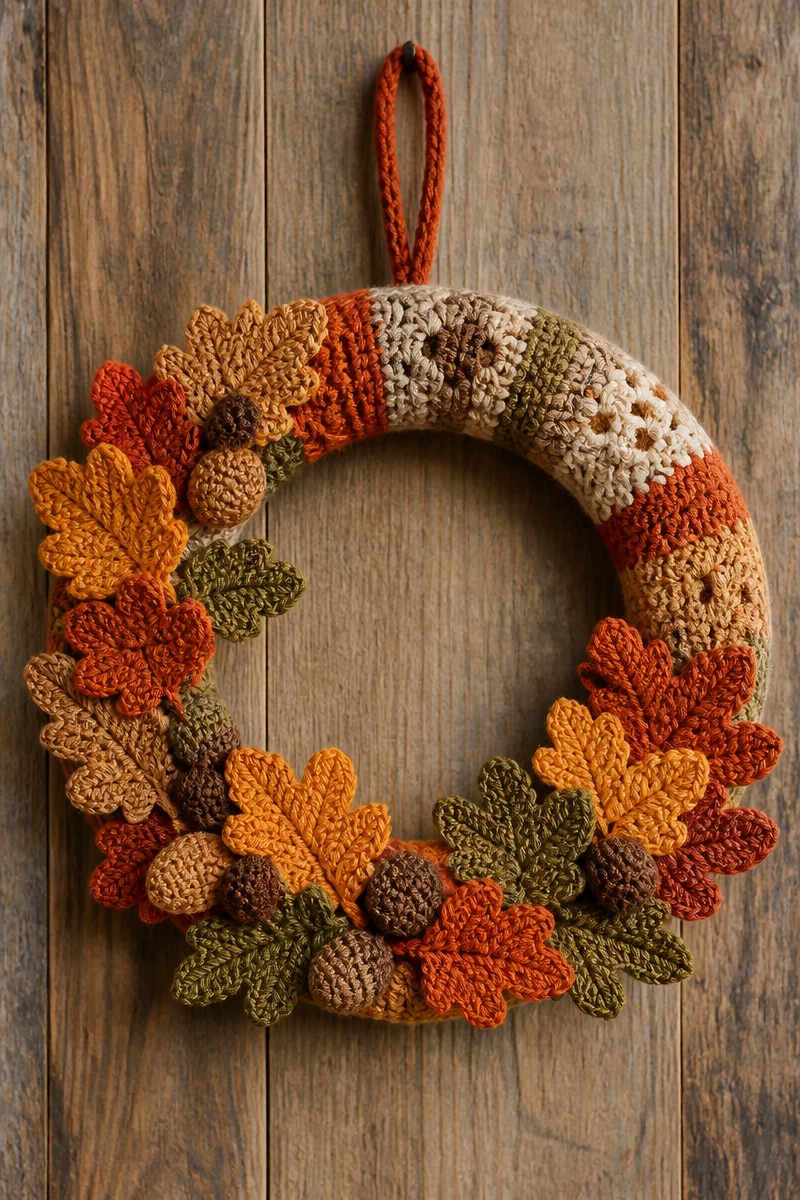
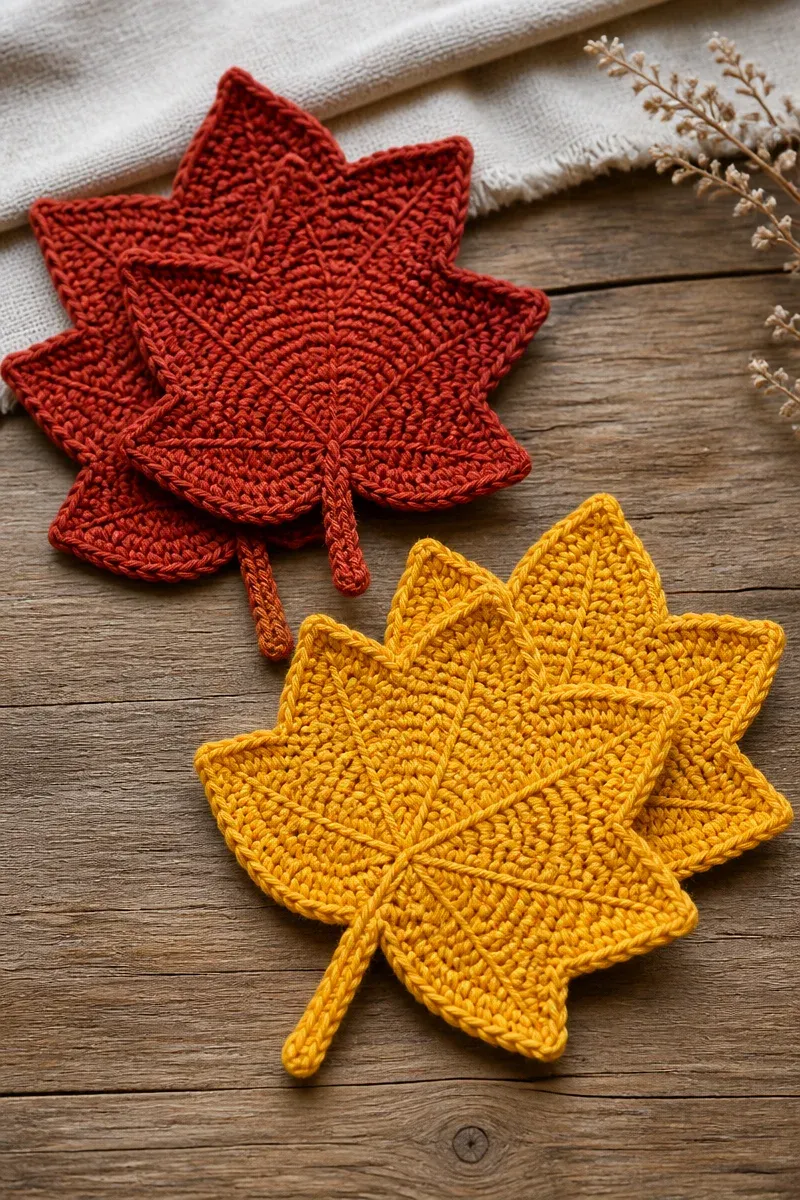
Woven from simple single crochet rounds, these coasters draw their charm from the subtle shaping that transforms flat circles into autumn leaves. The pattern relies on geometric increases spaced evenly around a perfect circle to keep your edges neat, then uses blocking techniques to create pointed leaf tips and a distinct stem. Cotton yarn was chosen for its absorbency and durability, supporting both practical use under mugs and the crisp blockability needed for maintaining leaf shape. I tested several cotton brands; a smooth, mercerized cotton yields a cleaner finish, while a softer, unmercercized cotton gives a more rustic texture but soft edges.
Worked in worsted weight cotton on a 4 mm hook, this project balances speed and detail. The stitches accumulate steadily by six each round, fitting evenly around the circle, so your coaster grows evenly without distortion. Adding hand-embroidered veins and a crocheted stem gives a natural leaf look without complicated shaping. These coasters make an excellent small gift or a seasonal touch on your table and can be easily adapted with different colors or yarns to match your décor.
Why You’ll Love This Leaf Coaster
The standout feature is its simple round-to-leaf shaping: no complicated stitch patterns or uneven motifs, just steadily increasing single crochets and strategic blocking to create five distinct points. Using cotton yarn enhances functionality—quick drying and washable—while providing a smooth surface ideal for embroidery. The pattern is quick to make, minimal in finishing steps, and practical enough to handle everyday use. Plus, the contrasting autumn hues provide a warm aesthetic perfect for seasonal decoration or gifting.
Materials
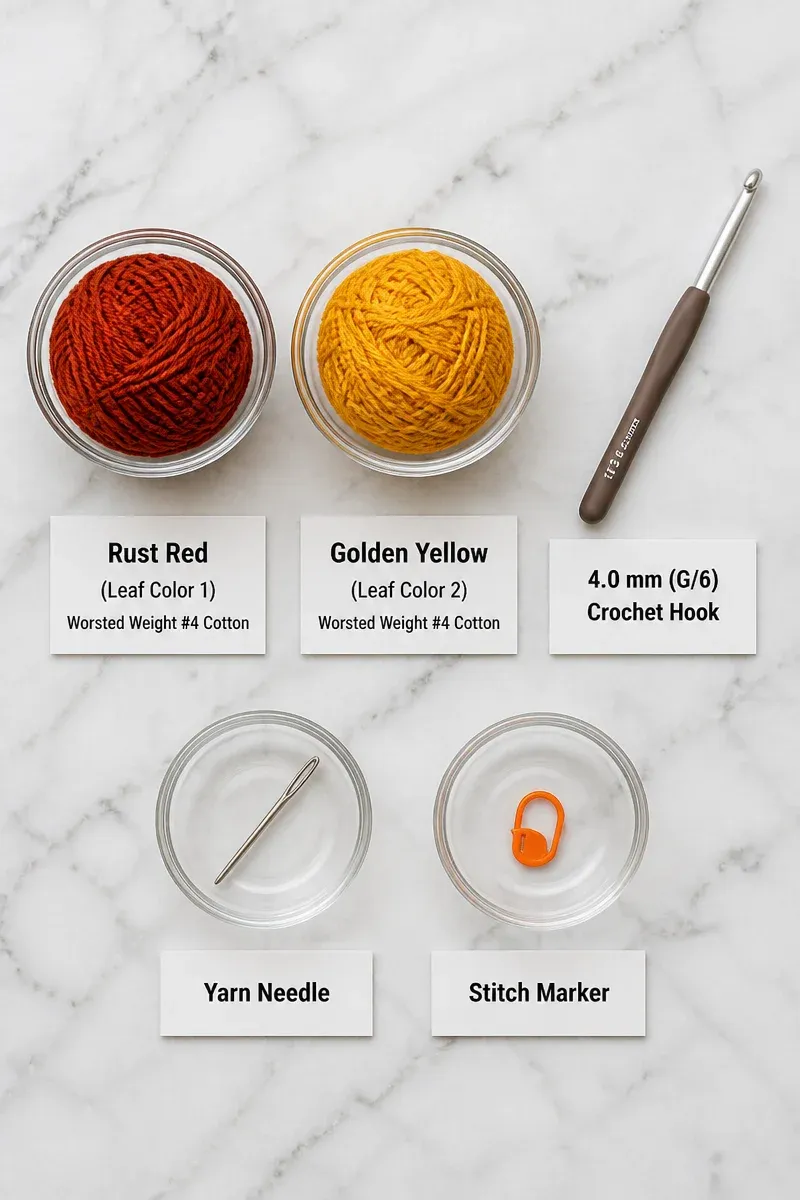
- Hook: US G/6 (4mm) crochet hook
- Yarn: Worsted weight (#4) cotton
- Rust Red, approximately 60g (~120 yards)
- Golden Yellow, approximately 60g (~120 yards)
- Notions: Yarn needle, stitch marker
Gauge
16 stitches and 16 rows = 4 inches (10 cm) in single crochet
Finished Size(s)
Each leaf measures approximately 4 inches (10 cm) in diameter before blocking and shaping.
Special Stitches and Techniques
- Increase (inc): Two single crochets in one stitch.
- Steam blocking to shape: Pinch the flat disc at 5 evenly spaced points to form leaf points, then lightly steam with an iron until set. Allow to dry fully before removing pins.
- Embroidering veins: Using the yarn tail, embroider 3-5 straight lines radiating from the center to edges to mimic leaf veins.
- Stem foundation chain: A chain of 12 stitches worked and then slip stitched back to form a firm crocheted stem, attached securely at one leaf point.
Abbreviations
- ch: chain
- sc: single crochet
- sl st: slip stitch
- inc: increase (2 sc in same stitch)
- rnd: round
Cotton Yarn Tips
Cotton yarn in worsted weight offers excellent stitch definition, useful for the smooth rounds in this pattern. It tends to have less elasticity than acrylic or wool, so tension should be consistent but not overly tight to maintain flexibility. Mercurized cotton will polish the stitch surface, producing crisper stitch edges and easier blocking, but may also feel stiffer. Unmercurized cotton softens over time but might fuzz or pill faster. Cotton handles steam blocking well, holding the shape after pinching, but care must be taken not to over-steam or saturate completely, which can distort stitches. Washing cotton pieces is straightforward; they dry quickly and resist felting.
Options for Substitutions
- Substitute with a DK weight cotton using a smaller hook (3.5 mm) to achieve a slightly smaller coaster while maintaining leaf detail.
- Use a cotton-acrylic blend for softer drape and easier stretch, noting that blocking may be less crisp.
- Choose a linen or hemp blend yarn for a more rustic texture and added durability, but expect a coarser fabric.
- Swap the rust red and golden yellow shades for other seasonal tones like burnt orange or deep burgundy to suit different décor.
- Use a 3.75 mm hook for a tighter fabric or 4.5 mm for a looser fabric, adjusting gauge and finished size accordingly.
- Pick a variegated cotton yarn with autumn shades for a multicolored leaf effect, noting that vein embroidery may blend more with variegation.
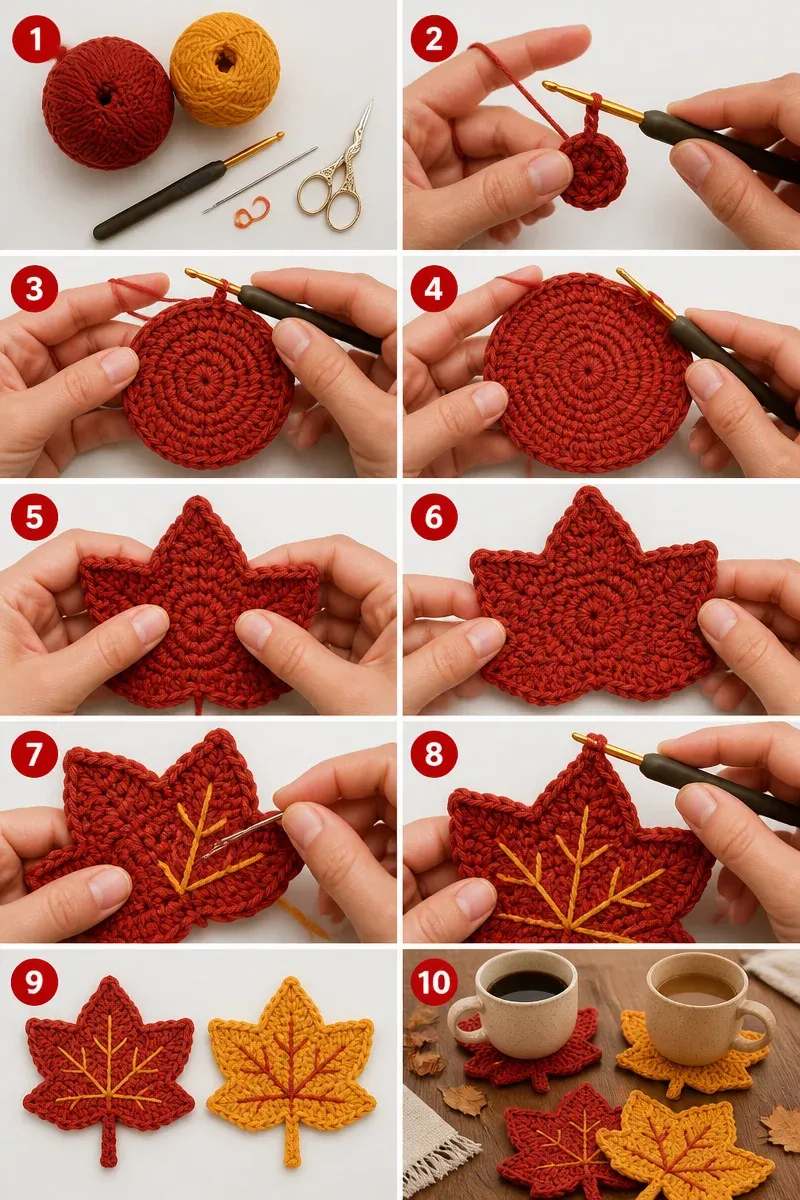
Pattern
Leaf (Make 4 total: 2 Rust Red, 2 Golden Yellow)
Begin with a foundation chain:
Ch 2 (counts as first stitch – the 2nd ch from hook is the first stitch worked into)
Rnd 1: 6 sc in 2nd ch from hook (6 sts)
Rnd 2: inc in each st around (12 sts)
Rnd 3: sc 1, inc repeat 6 times (18 sts)
Rnd 4: sc 2, inc repeat 6 times (24 sts)
Rnd 5: sc 3, inc repeat 6 times (30 sts)
Rnd 6: sc 4, inc repeat 6 times (36 sts)
Rnd 7: sc 5, inc repeat 6 times (42 sts)
Rnd 8: sc 6, inc repeat 6 times (48 sts)
Fasten off leaving a long tail for embroidery and stem attachment.
Leaf Shaping and Finishing
- Lay the disc flat. Pinch and lightly steam-block at 5 evenly spaced points around the edge to create five leaf points. Hold pins in place until dry and shape is set.
- With long tail, embroider 3 to 5 straight vein lines from the center outward using the same yarn color, anchoring threads securely on the back.
- Create the stem: chain 12, turn and sl st back along the chain. Attach stem to one leaf point by sewing it securely with the yarn tail, reinforcing with multiple stitches to prevent detachment.
- Weave in all ends. Block the entire leaf flat again to refine shape.
Assembly
No assembly beyond finishing steps is required. Each leaf is a standalone coaster. Place them as a set on your table for coordinated autumn décor.
Watch Out for These Mistakes
Avoid uneven tension on the initial rounds. Because the pattern builds with consistent increases (+6 stitches per round), too tight stitches will distort the circular shape and make blocking difficult. Also, when pinching the leaf points, be precise; uneven spacing will throw off the leaf silhouette. Use a stitch marker to divide the edge evenly before pinching if needed. When embroidering veins, anchor yarn tails carefully on the backside so threads do not loosen through use.
The stem attachment must be secure; a loosely sewn stem can pull away with repeated use or washing. Reinforce stitches at the base and confirm the stem lies flat against the leaf surface.
Check that your ch-12 stem is long enough and slip-stitched firmly for consistent thickness; too loose a stem will bias when the coaster is handled.
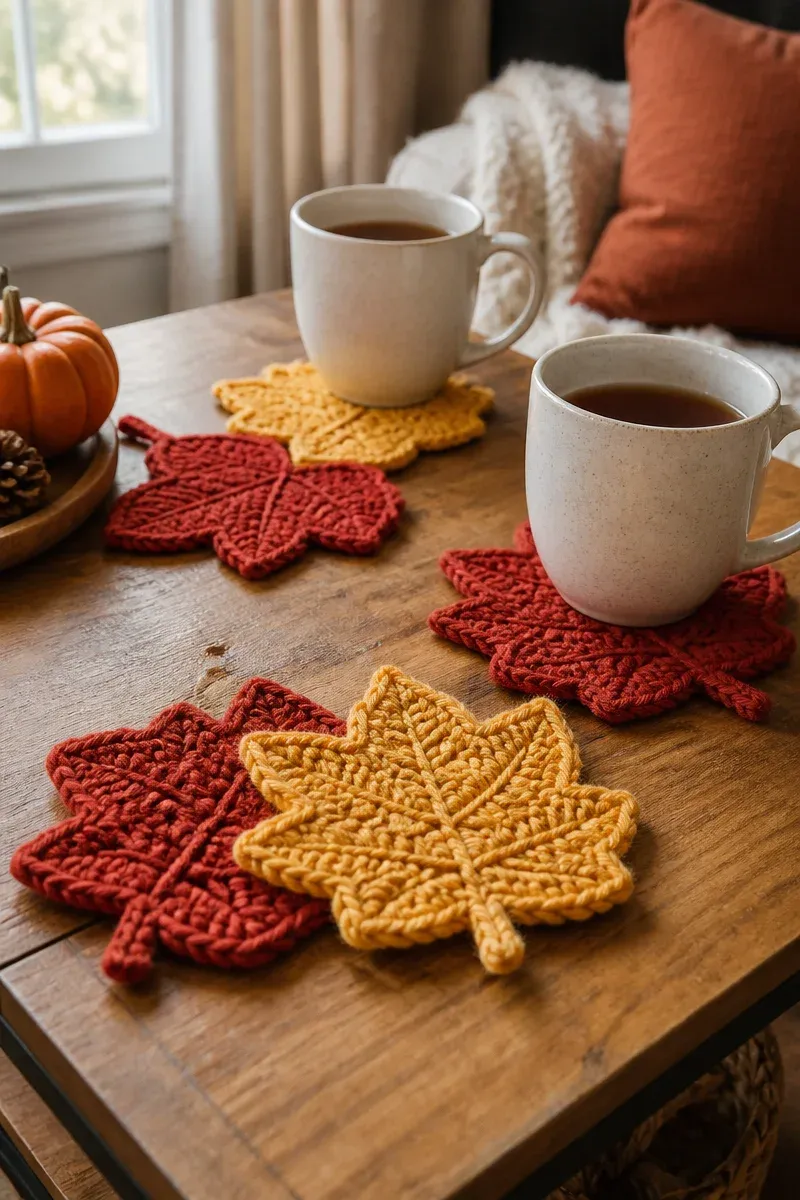
Care and Washing Instructions
Hand wash or machine wash on gentle cycle using cold water to preserve cotton and colors. Lay flat to dry after reshaping as needed. Steam blocking can be refreshed after washing, but avoid high heat irons directly on fibers that may scorch. Mercerized cotton maintains crispness; unmercercized cotton softens with repeated washing but may lose some shape retention. Store coasters flat to prevent distortion.
Questions About Making This Leaf Coaster
Q: Can I make these coasters in other yarn weights?
A: Yes, but gauge and hook size must be adjusted. Using lighter yarn will produce smaller leaves unless you increase rounds proportionally.
Q: How tightly should I crochet?
A: Maintain consistent tension producing fabric that isn’t stiff but holds shape. Too tight causes curling; too loose loosens the circle’s edge.
Q: Is steam blocking necessary?
A: Yes. Blocking defines the leaf’s shape. Without it, the coaster will remain a flat circle.
Q: Can I add more than five leaf points?
A: Five points align with the increase pattern of six stitches per round and create a balanced shape. More points would require redesigning increase spacing.
Q: How to clean embroidered veins if they get soiled?
A: Gently hand wash with minimal agitation and avoid harsh detergents; embroidery yarn matches the base to minimize visual dirt.
Q: Can I make a coaster without the stem?
A: Yes, omitting the stem simplifies finish but reduces the distinctive leaf detail.
Q: Can these be used under hot mugs?
A: Cotton tolerates heat well; however, avoid placing extremely hot items to protect fiber longevity.
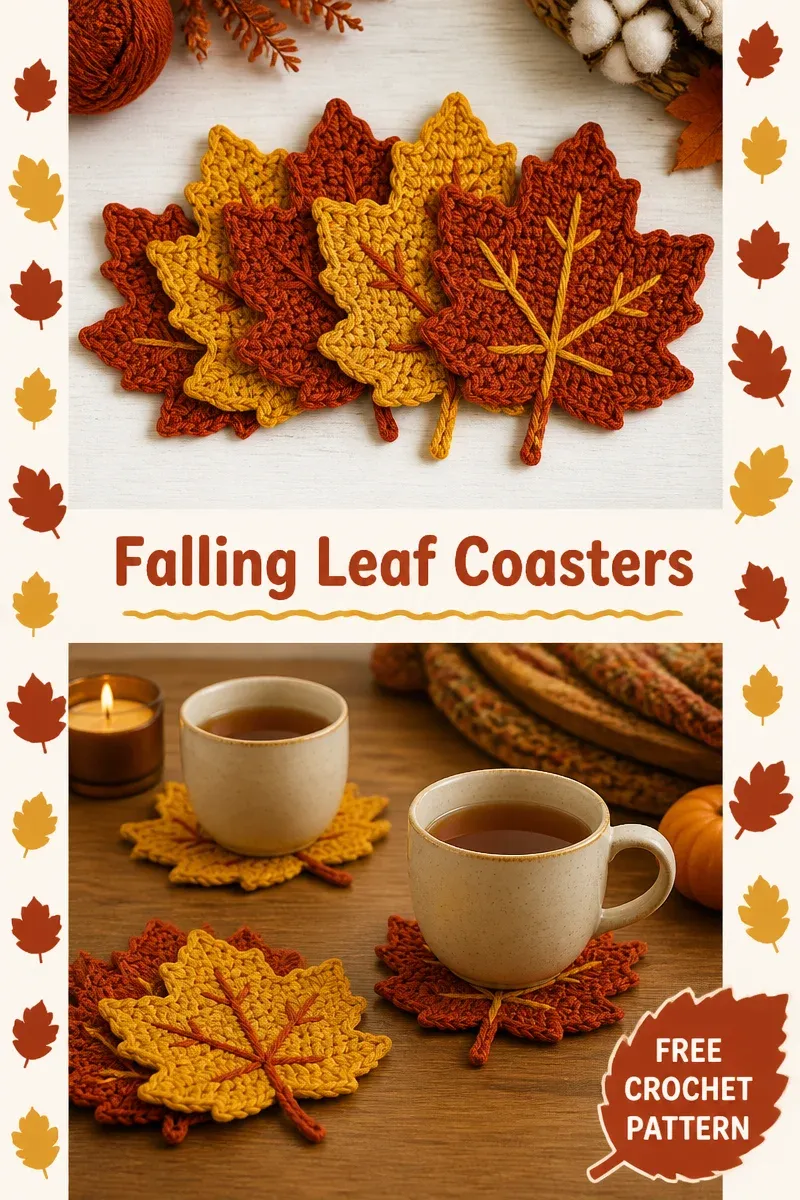
The final shape and finish turn simple rounds into a recognizable seasonal motif with enduring usability. Share your finished leaves and their place in your seasonal décor.